




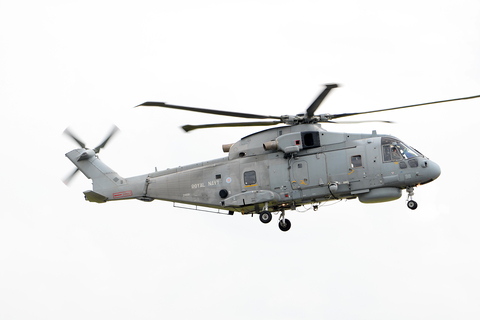
 Two years after a Merlin HC Mk 4 flying from HMS Queen Elizabeth ditched in the sea off Dorset, killing Lt Rhodri Leyshon, the board of enquiry report has finally been published. The inquiry found that a fractured engine component triggered an emergency that the crew misdiagnosed, after which two serviceable engines were shut down, leaving the helicopter without power at low level over the sea at night. The report revealed that a component failure, ambiguous cockpit warnings, and crew misdiagnosis led to the fatal ditching.
During a night deck-landing exercise from HMS Queen Elizabeth, a split fuel pump diaphragm on engine two caused a sudden power surge. The aircraft's management system automatically throttled back engines one and three to compensate. Due to ambiguous cockpit warning logic, the crew misdiagnosed this as a double-engine failure and manually shut down the two functional engines. Engine two then tripped its overspeed protection, leaving the helicopter without power.
The investigation cited several compounding factors, including component testing procedures by engine maker Safran, reduced crew flight currency, a breakdown in crew resource management and equipment issues during the post-crash rescue.
img: ID 192481707 © Burnstuff2003 | Dreamstime.com
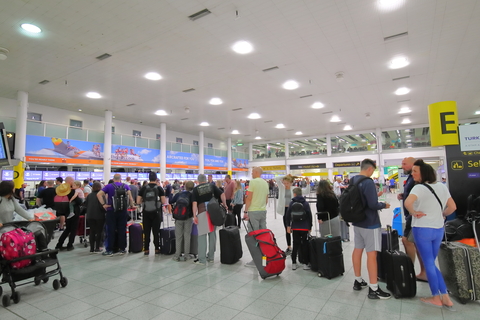 A major technical failure at National Air Traffic Services (NATS) on 8th September 2026, caused widespread travel chaos across the UK. A system glitch at the Swanwick control center disrupted flight plan processing, forcing air traffic controllers to halt departures. The outage led to over 1,750 flight cancellations and affected more than 300,000 passengers across major airports, including London Heathrow, Gatwick, Manchester, and Stansted. Heathrow briefly halted incoming flights due to gate congestion.
Engineers fixed the issue within four hours, but knock-on delays persisted for days while airlines repositioned aircraft and crew. NATS ruled out a cyberattack, yet Transport Secretary Heidi Alexander ordered an independent review by the Civil Aviation Authority and demanded a full report within a week. Major airlines, including Ryanair and Wizz Air, condemned the outage, noting it was NATS's third major technical failure in three years.
https://www.bbc.co.uk/news/articles/ce8x3dp1zpxo
img: ID 155236599 | Airport © Tktktk | Dreamstime.com
 The race to deploy autonomous, fixed-wing aircraft is accelerating, led by pilotless crop dusters and cargo delivery planes rather than urban air taxis. California-based start-up Pyka has secured US commercial authorization for its fully electric, autonomous crop sprayer, which flies lower than human pilots to reduce chemical drift.
Meanwhile, British firm Windracers is seeking permission for heavy-lift cargo services.While autopilot merely assists, fully autonomous systems handle entire flights via software algorithms. However, strict aviation safety standards have slowed deployment compared to self-driving cars.
Companies are currently divided over artificial intelligence; some leverage generative AI and cameras for communication and obstacle detection, while others strictly avoid AI to ease regulatory certification.
Supporters argue automation cuts costs and improves safety, but pilots' groups remain highly wary, calling the removal of human crews a serious gamble.
https://www.bbc.co.uk/news/articles/c1l123mmrg7o
img: ID 160640227 | Crop Duster © Pix569 | Dreamstime.com
 A £5 million UK project is turning to artificial intelligence to help passenger jets dodge the climate-warming condensation trails left in their wake. Known as Operation Blue Skies, the 30-month initiative involves Google, the UK government, NATS, and the Met Office. It targets Shanwick airspace in the eastern North Atlantic, an area responsible for roughly 5% of global contrail warming.
Contrails form when jet exhaust meets freezing, humid air, trapping heat that would otherwise escape the atmosphere. Experts estimate these clouds account for up to a third of aviation’s total climate impact.
By pairing satellite imagery, flight data, and weather models, AI will predict where persistent contrails will form. Controllers can then prompt pilots to adjust their altitude by roughly 2,000 feet to avoid these atmospheric zones. Over two trial winters, 10,000 flights will test the system to prove its impact.
https://www.bbc.co.uk/news/articles/c62em5lpvnjo
img: ID 105370170 © Dezzor | Dreamstime.com
 Scientists have taken a major leap in synthetic biology by using generative AI to design functional viruses from scratch. Researchers from the Arc Institute and Stanford University utilized a biological genome language model (Evo 2)—trained on millions of natural DNA sequences—to author complete biological genomes.
The team synthesized these AI-generated blueprints in the lab, successfully creating 16 novel, viable bacteriophages (viruses that target and destroy bacteria). In lab tests, a cocktail of these AI-designed phages effectively wiped out E. coli strains, including those resistant to natural viruses.
This breakthrough proves whole-genome AI design is possible, offering a promising new weapon against drug-resistant "superbugs" through custom phage therapies. However, experts urge caution: the dual-use technology that enables life-saving medicine could potentially be exploited to engineer dangerous new pathogens, underscoring the urgent need for robust global biosecurity regulations.
https://www.bbc.co.uk/news/articles/c5y3j3ngevmo
img: AI generated (Midjourney)