




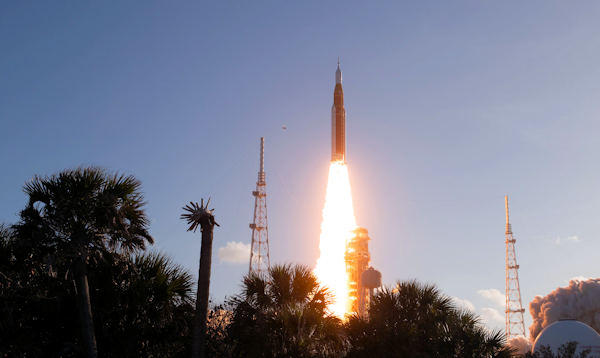
 The first crewed mission to travel to the Moon in over 50 years is underway with Artemis II having successfully launched from Florida’s Kennedy Space Centre. Following a nervous countdown – where multiple minor faults were identified and solved by NASA – lift-off took place on 1st April 2026 at 11:35pm BST.
The Orion spacecraft carrying the mission’s four astronauts was propelled to space by NASA’s SLS (Space Launch System) rocket and begins its mission with an elliptical orbit around Earth. Over the following 10 days, Orion will travel more than 400,000km to the Moon, performing a lunar fly-by before returning to Earth and splashing down in the Pacific Ocean.
https://www.theengineer.co.uk/content/news/artemis-ii-moon-mission-launches-successfully
img: NASA public domain
 The US artificial intelligence (AI) firm Anthropic is looking to hire chemical weapons and high-yield explosives experts to try to prevent "catastrophic misuse" of its software. The company fears that its AI tools might tell someone how to make chemical or radioactive weapons, and wants an expert to ensure its guardrails are sufficiently robust.
In the LinkedIn recruitment post, the firm says applicants should have a minimum of five years experience in "chemical weapons and/or explosives defence" as well as knowledge of "radiological dispersal devices" – also known as dirty bombs.
But some experts are alarmed by the risks of this approach, warning that it gives AI tools information about weapons - even if they have been instructed not to use it.
https://www.bbc.co.uk/news/articles/c74721xyd1wo
img: midjourney
 A new class of cybersecurity vulnerability has emerged, known as environmental indirect prompt injection, where physical road signs are used to hijack the decision-making processes of autonomous vehicles and drones.
Researchers from the University of California, Santa Cruz (UCSC) developed a method called CHAI (Command Hijacking against Embodied AI). This attack exploits Large Vision-Language Models (LVLMs) that power "embodied" AI – systems that interact with the physical world. Unlike traditional prompt injection, which occurs via text files or web pages, CHAI uses visual cues in the environment.
By placing specific text on road signs, attackers can force an AI to interpret the sign as a direct command rather than a piece of passive environmental data. In tests, the researchers successfully tricked self-driving cars into ignoring stop signs or driving through pedestrian crossings even when pedestrians were present.
https://www.theregister.com/2026/01/30/road_sign_hijack_ai
img: midjourney
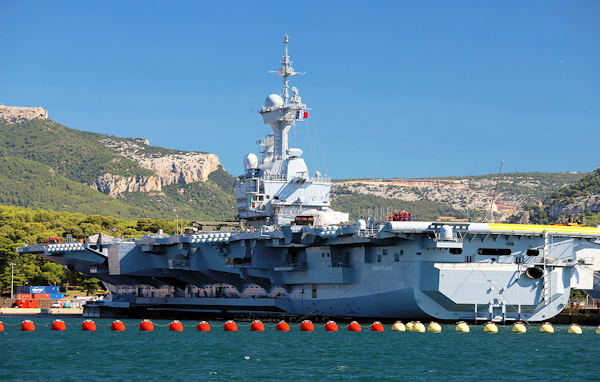 The French Ministry of the Armed Forces recently took "appropriate measures" after a naval officer inadvertently exposed the location of the nuclear-powered aircraft carrier Charles de Gaulle via the fitness-tracking app Strava.
The breach occurred while the officer was jogging on the carrier’s deck with a GPS-enabled device. Strava’s "Global Heatmap" feature, which aggregates user data to show popular exercise routes, displayed a distinct pattern of activity in the Mediterranean Sea. This allowed open-source intelligence (OSINT) analysts to pinpoint the vessel’s exact coordinates and track its movements in real-time, compromising a high-stakes military asset whose location is usually classified.
While the French Navy downplayed the immediate tactical risk – noting that adversarial satellites already monitor the ship – the incident highlighted how seemingly innocuous data can play a significant part in system safety if not managed correctly.
The Data Safety Initiative Working Group is committed to raising the awareness of the role data can play in system safety and has produced guidance on how to manage these risks.
https://www.bbc.co.uk/news/articles/cd9vdel17wqo
img: ID 125281383 © Kovalenkov Petr | Dreamstime.com
 Vessels and aircraft in the Middle East, particularly near the Iranian coast and the Strait of Hormuz, are experiencing intense "GPS spoofing." This causes their navigation systems to show false locations – sometimes making ships appear to be miles inland on dry land.
By disrupting Automatic Identification Systems (AIS), the jamming significantly increases the risk of collisions and maritime accidents in some of the world’s busiest and most strategically sensitive shipping lanes.
While no state has officially claimed responsibility, military analysts suspect Iran is the primary actor, possibly using domestically produced technology or tools sourced from Russia and China. It is also noted that the U.S. employs similar defensive technology to protect its assets.
The crisis is driving demand for "anti-jamming" hardware and alternative navigation systems that don't rely on satellites, instead using star-mapping or optical imagery to determine location. Experts warn that we are entering an era where GPS can no longer be trusted as a "set and forget" utility, forcing a shift toward more secure, resilient navigation infrastructure.
https://www.bbc.com/news/articles/c3ewwlx9e1xo
img: ID 132074966 | Shipping Vessel © Mr.siwabud Veerapaisarn | Dreamstime.com